
simnel cake
an historical Easter treat

This week, in the lead up to Easter, I wanted to share a little bit about one of my favourite Easter bakes, one that I bake every year, the simnel cake. It’s not particularly well known outside of the UK, but has a long, interesting history. And on Friday, for paid subscribers, I’m sharing recipes for a couple of other traditional Easter treats - a biscuit and an Italian bread bun. Happy reading.
Julia x
Easter always seems like a much less fraught holiday than Christmas. The expectations around family, gift-giving and food don’t seem to exist, or at least not to the same extent. For those of us in the southern hemisphere, it’s a chance for a last warm weather hurrah before winter arrives. Popular beach locations are always packed over Easter. For plenty of other people, avoiding the busy roads and staying at home is the ideal way to while away a few days break.
For our family, Easter isn’t a religious holiday, rather it’s an opportunity to spend time with family and friends and to embrace a slower pace for a few days. Despite that, I still love the traditions that surround holidays such as Christmas and Easter, and Easter is full of food that has symbolic meaning. I refuse to eat hot cross buns on Boxing Day, or even to look at the Easter eggs that seem to appear on the shop shelves before the end of January. The uniqueness of these occasions, is there, in part because of the small window of time to indulge in specific food prepared only at that time of year.
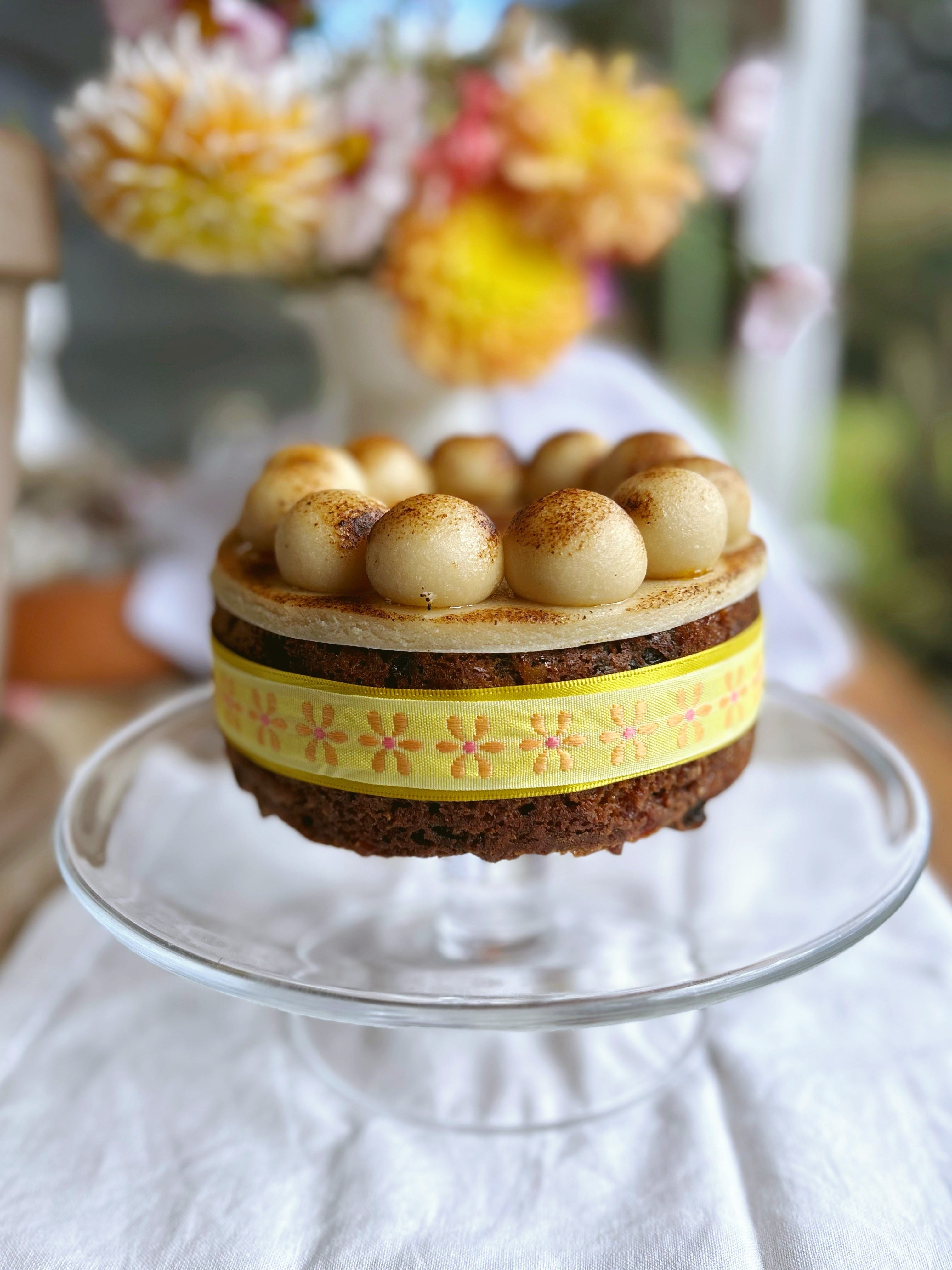
This is where simnel cake comes in. I’ve been making this traditional English cake for years, although it isn’t particularly well known in Australia, and by some accounts, is losing popularity in the UK. Simnel cake is a fruit cake, lighter than a Christmas cake, with a layer of marzipan in the middle and a layer on top. It is decorated with 11 marzipan balls, representing the disciples minus Judas. Simnel cake wasn’t always associated with Easter, but initially with Mothering Sunday, the forerunner to what is now Mother’s Day. Mothering Sunday occurs on the fourth Sunday of Lent and was when people used to visit their mother church or cathedral. It offered a brief respite, food-wise, from the austerity that characterised Lent. Over time, the day became one where servant girls would return home and visit their family and church, taking with them gifts, often in the form of a simnel cake. The ingredients would have been pilfered or gifted from their mistress, with thoughts that the more highly regarded the servant, the better the ingredients. The cake would be set aside and eaten on Easter Sunday, hence the beginning of the simnel cake’s association with Easter.
The name derives from the Latin samila, which referred to the finest of white flours, which and used to bake the first simnel cakes, which were more bread than cake. Originally made in mediaeval times, although perhaps even earlier, it was a yeast leaven bread, which morphed during the 17th and 18th centuries into something more pudding-like. The dough was enriched with fruit, spices and almonds, boiled and then wrapped in pastry coloured with saffron, and baked. It was not until the 19th century that it became more cake like and in the 20th century, marzipan was added. Food historian, Dr Neil Buttery has written about simnel cakes and also has a podcast series on Lent, including a discussion about simnel cakes
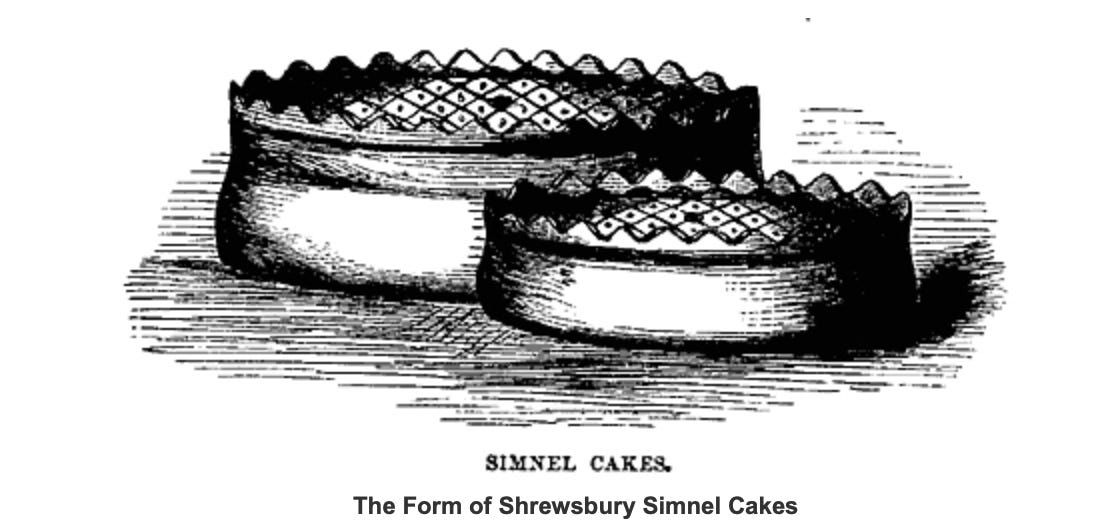
This best recognised simnel cake is also known as the Bury simnel cake, thought perhaps to have become more popular due to promotions in the town where in 1863, Queen Victoria was presented with a 70 pound simnel cake. There are other regional variations of simnel cake. The Shrewsbury simnel cake is a light fruit cake, flavoured with saffron, boiled and then baked. It is decorated with marzipan, often in points rather than balls. The Glouchester simnel cake is similar but has the addition of glacé fruit as part of the decorations. The Devizes simnel cake comes from Wiltshire, and, unlike the other versions, is undecorated but shaped like a star. An early recipe from the Wiltshire Heritage Museum reads:
Three and half lbs plain flower, Three lbs currants, 2 lbs lemon peel, Half oz saffron mixed with bun powder and egg yoke, Prove well, form into star shapes. Boil, then bake. Glaze.
This is my recipe for simnel, cake, the one I make each year. I like my fruit cakes a little boozy, so I soak my fruit in whiskey. You can do this just overnight or for a few days, similarly, if you prefer rum or brandy, you can use that. Mixed peel is always controversial, but I enjoy it in cakes, although you can always increase the amount of currants in the recipe. Similarly, glacé cherries are a bit ‘love them or hate them’. I’ve noticed recently that the colour of glacé cherries has changed to a more natural one. I’m not usually a great advocate of food colouring, but really much of the appeal of glacé cherries is the pop of colour they bring to a cake - it’s not as if they taste of much! So I’ve been searching out the very unnatural bright red ones.
Where we are, it’s not always easy to buy plain marzipan, especially outside of Christmas, so I generally make my own. It’s really not difficult, and for me, means that I can make slightly more than I need to accommodate snacking along the way! This recipe uses egg white, which for the decorations, won’t be cooked. I am happy to use egg white at home; however, if I’m making marzipan for cakes at the markets, I substitute the egg white for liquid glucose, which you can do if you’re concerned about the egg white. This will result in a slightly softer marzipan.

Marzipan
340 g almond meal
340 g icing sugar
2 teaspoon almond essence
2 egg whites (or about 180 ml liquid glucose)
This will make a little more marzipan than you need for the recipe. Roll the leftovers into small balls and then roll in good quality cocoa powder. Leave to set slightly, before eating. We call these marzipan potatoes, and they are a wonderful alternative Easter treat.
Put the ingredients into the bowl of a food processor and whizz until it comes together.
Tip it out onto the kitchen bench, dusted with a little icing sugar, and knead until it comes together.
If you’re not using it straight away, wrap it well and keep it in the fridge for a couple of weeks.
Simnel Cake
Begin this recipe at least the day before
200 g sultanas
150 g currants
60 g mixed peel
50 g glacé cherries, cut in half
50 g glacé or crystallised ginger, finely chopped
zest and juice of 1 orange
100 ml whiskey
240 g butter, softened
240 g brown sugar
4 eggs
220 g plain flour
1½ teaspoons baking powder
1 teaspoon mixed spice
500 g marzipan
80 g apricot jam
Put the dried fruit, orange zest and juice, and whiskey into a bowl and leave to soak at least overnight, and up to a week.
Preheat the oven to 150°C and grease and line a 20 cm diameter round cake tin.
Cream the butter and sugar in the bowl of a stand mixer for 3-4 minutes or until it is fluffy and changed in colour. Add the eggs one at a time, making sure each egg is incorporated before adding the next. Add the flour, baking powder and mixed spice and mix until combined. Stir through the soaked fruit.
Spoon half the batter into the cake tin and smooth out the top a little. Take one third of the marzipan, sprinkle the bench top with a light dusting of icing sugar and roll into a 20 cm diameter circle. Place it on top of the batter. Spoon in the remaining batter.
Bake for 2 hours, or until golden and the cake springs back when pressed gently in the centre. You can test with a skewer, but remember there’s marzipan in the middle, which makes it a little trickier.
Remove from the oven and leave in the tin for 20 minutes before turning it out and cooling completely on a wire rack.
Split the remaining marzipan in half. Roll one half into a circle slightly larger than 20 cm diameter. Use a plate as a template to cut a straight edged circle, to fit the top of the cake. Roll the remaining marzipan into 11 balls.
Put the apricot jam into a small saucepan and heat gently. Brush the jam over the top of the cake and place the marzipan circle on top. Dip each of the balls into a little of the jam and place around the edge of the cake.
I use a kitchen blow torch to lightly brown the marzipan; however, you can achieve the same effect by popping the cake under a hot grill for a couple of minutes, until the marzipan is golden. Make sure to keep a close eye on it. The cake will keep well in an air-tight container for several weeks.
